Practical
Antelope Canyon Weather: The Best Time to Visit, Month by Month
Antelope Canyon weather is high-desert weather. The canyon lies on the Navajo Nation just outside Page, Arizona, where, by the NOAA normals for Page, summer afternoons reach the mid 90s, winter mornings start in the 20s, and the whole year brings under seven inches of rain. Tours run in every month. What changes through the year is how you dress, which tour time is comfortable, whether the famous light beams are likely, and, from July to September, how closely everyone watches the sky.
The short answer for most travelers: spring and fall give the most comfortable days, summer gives the best chance of light beams in Upper Antelope Canyon along with the heat and the monsoon, and winter gives cold mornings, soft light and the thinnest crowds. One Lower Antelope Canyon operator, asked for a single recommendation, names late April or the first half of October. Below: the numbers month by month, what each season is really like, the flash-flood rules, the light, the clock and what to wear.
Antelope Canyon weather by month
These are the 30-year NOAA climate normals for Page, Arizona (1991-2020), as published by a Lower Antelope Canyon operator. Treat them as the shape of a typical year rather than a forecast for your date.
| Month | Average high | Average low | Rain |
|---|---|---|---|
| January | 45°F | 26°F | 0.7 in |
| February | 51°F | 30°F | 0.5 in |
| March | 62°F | 38°F | 0.5 in |
| April | 71°F | 44°F | 0.4 in |
| May | 81°F | 54°F | 0.4 in |
| June | 92°F | 63°F | 0.1 in |
| July | 97°F | 70°F | 0.6 in |
| August | 94°F | 68°F | 0.9 in |
| September | 85°F | 59°F | 0.9 in |
| October | 71°F | 47°F | 0.9 in |
| November | 55°F | 35°F | 0.5 in |
| December | 44°F | 27°F | 0.4 in |
Two things stand out. The first is the gap between high and low: the same operator says a 30 degree swing between morning and afternoon is normal around Page, so the temperature when you check in is often not the one you started the day with. The second is how little it rains. Even the wettest months, August, September and October, average under an inch. The rain that matters is not the total but where and how fast it falls, which is the subject of the monsoon section below.
What the desert does through the year
The National Park Service, which runs the neighboring Glen Canyon National Recreation Area, sums up the regional climate in four lines. Summers are extremely hot with little, if any, shade. Winters are moderately cold, with night lows often below freezing. Spring is highly variable and unpredictable, with extended periods of wind. Fall is usually nice and mild, which the Park Service calls a great time to beat the heat and the crowds.
The Park Service also gives the extremes: temperatures in Glen Canyon can range from 110°F in June and July to 0°F in December and January, and precipitation is generally light, less than 6 inches a year, though heavy rain and flash flooding are possible during the summer and fall monsoons. Its clothing advice follows from that: lightweight, light-colored clothing and a hat in summer, and layers the rest of the year.
The Navajo parks department, which manages the canyon itself, puts it in terms of its own backcountry: in summer the trails are hot and dry, and in winter the elevation leaves them open to severe cold and high winds. Upper Antelope Canyon sits at about 4,000 feet, and Lower Antelope Canyon at about 3,704 feet, so the canyon is not low desert. Cold is a real part of the year.
Spring: March to May
Spring is when Page wakes up. March averages a high of 62°F and a low of 38°F; by May the high is 81°F and the low 54°F. Rain is scarce. April is one of the most comfortable months of the year, warm by day and cool in the morning, and late April is one half of the Lower operator’s single recommendation.
The catch is wind. The Park Service describes spring weather as highly variable with extended windy spells, and the Lower operator says spring wind mostly means blowing sand on the walk in. Bring sunglasses, and expect a little sand to drift down from the rim inside the slot.
Spring is also when the crowds return. One Lower Antelope operator calls March to November peak season, when tours frequently sell out, so book ahead from March onward.
Summer: June to August
June is the driest month, with an average of 0.1 in of rain, and the heat climbs fast: 92°F in June, 97°F in July and 94°F in August are the average highs. Operators warn that afternoons can pass 100 degrees, and the Park Service notes summers with little, if any, shade.
The good news is that the slot itself is cooler than the rim. One operator says the canyon is usually five to ten degrees cooler all year; another says roughly 10 to 15 degrees cooler than the outside air in summer. Either way, you still walk in open sun to reach it. At Lower Antelope it is roughly a 10-minute walk from the check-in booth to the canyon entrance and back, and at Upper Antelope you ride out in a tour truck and finish with a hike up and over the canyon.
How to handle summer:
- Pick the tour time with care. Morning tours are cooler for Lower Antelope; midday tours bring the beams in Upper but also the most heat outside.
- Hydrate the day before. One Lower operator advises drinking well at least a day ahead, since heat exhaustion is a common risk.
- Wear closed-toe shoes. Sandals are not allowed on Lower tours, and the sand and sandstone get hot.
- Plan around the bag rule. You cannot carry a bag into Lower Antelope, so leave what you do not need in the car.
Summer is also the season of the light beams in Upper Antelope Canyon, which is why it stays busy despite the heat. More on that below.
The monsoon and flash floods
The Navajo parks department is clear about when the danger peaks: flash floods are most likely during the summer monsoon season, July through September, but they can occur at any time of the year. The Lower Antelope operator that publishes the month-by-month normals dates the monsoon from roughly mid June through September, and the Park Service speaks of summer and fall monsoons. In practice, plan for storms from July to September and keep an eye on the forecast either side of that.
The reason it matters is the shape of the canyon. A slot canyon is a drainage. Rain falling dozens of miles away can funnel into the slots with little notice, which is why a tour can be paused on a perfectly sunny day. History shows what is at stake. On August 12, 1997, eleven tourists were killed in Lower Antelope Canyon by a flash flood after a thunderstorm dumped water into the basin about 7 miles upstream, though little rain fell at the canyon itself. On July 30, 2010, several visitors were stranded on a ledge when two flash floods hit Upper Antelope Canyon.
Today the canyons are run with that risk in mind:
- Ladders are bolted in place in Lower Antelope, cargo nets are installed at the top, and a NOAA weather radio and alarm horn are kept at the fee booth.
- Canyon X tours are cancelled whenever NOAA issues a flash flood warning for the area.
- Lower Antelope tours can pause on short notice during the monsoon when storms threaten the drainage upstream.
- Refunds: the operators say tours they cancel for weather are refunded in full, and one Lower operator also offers free rescheduling.
Rain alone does not cancel a tour. The Lower operator notes that light rain without a storm system feeding the drainage often means tours run normally. The decision is about runoff upstream, which is why it can change within the hour. If your trip falls in August or September, the same operator suggests booking your canyon day early in your stay, so you have room to move to a later day if a storm closes the canyon.
Fall: September to November
Fall is the season the Park Service singles out: usually nice and mild, a great time to beat the heat and the crowds. September still carries the tail of the monsoon, with an average high of 85°F, and October, at 71°F by day and 47°F at night, is the other half of the Lower operator’s recommendation. The same operator calls fall the calmest stretch of the year for wind.
October averages 0.9 in of rain, the same as August and September, so the risk of a storm has not quite gone. By November highs are down to 55°F and lows to 35°F, and the crowds thin noticeably. The Canyon X operator names spring and fall as the best time to visit.
Winter: December to February
December is the coldest month in the normals, with an average high of 44°F and a low of 27°F; January is close behind at 45°F and 26°F. Mornings are genuinely cold, and the Lower operator notes that direct sun reaches the canyon floor for only part of the day, so the slot holds the chill. Dress in layers you can shed on the walk out, and wear shoes with grip on cold metal stairs.
There are good reasons to come anyway:
- Thin crowds. Winter is the quietest time of year in the canyons.
- Soft light. Operators describe deep, glowing reds and purples rather than harsh contrast.
- Lower prices. One Upper Antelope operator says its rates vary by season, with discounts in late fall and winter.
- Year-round tours. That operator runs every day of the year and says the colors are still there in winter.
The tribal park closes on four days, all in this part of the year: Thanksgiving Day, Navajo Nation Family Day (the day after Thanksgiving), Christmas Day and New Year’s Day. Plan around them.
When the light beams appear
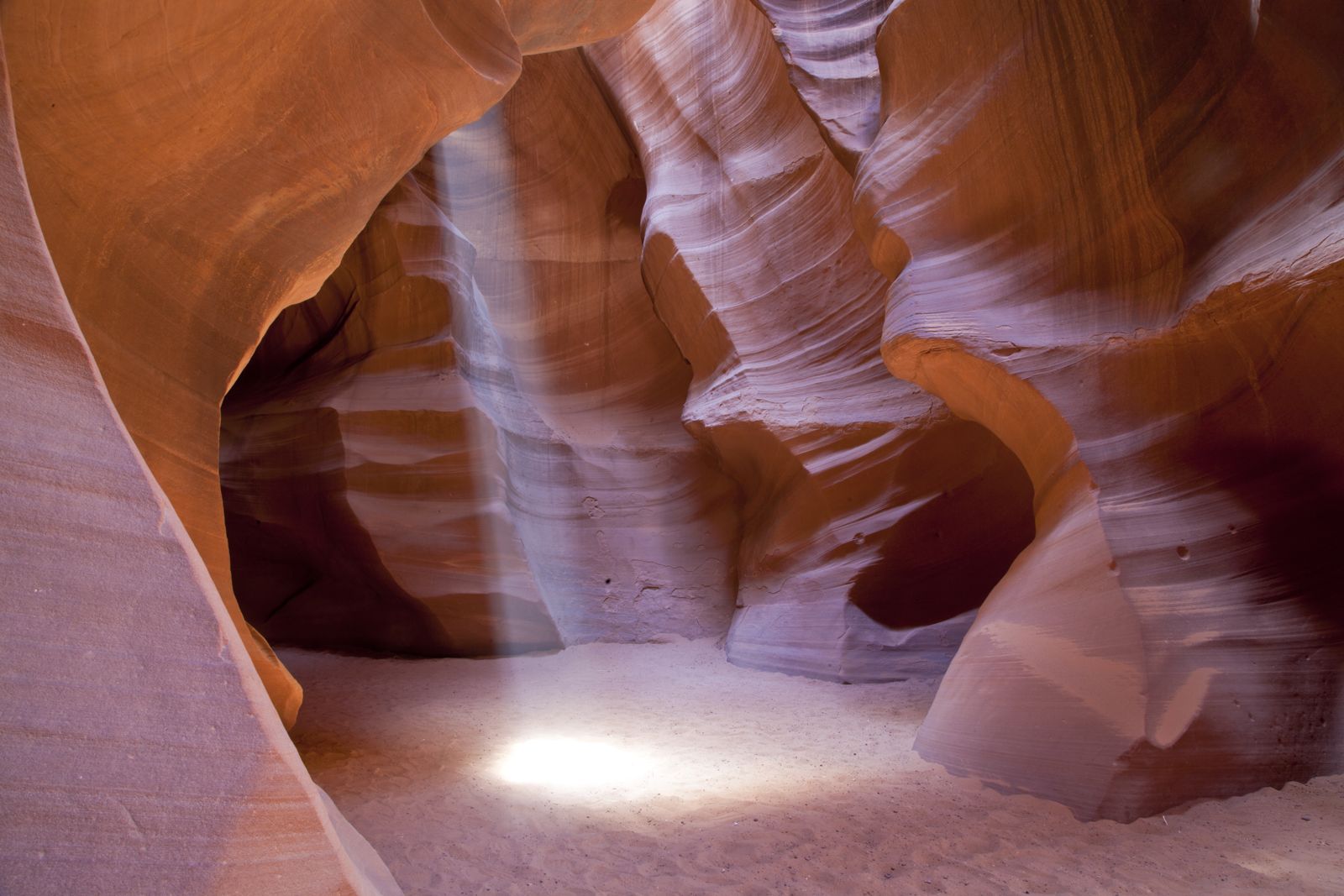
The overhead light beams, the shafts of sun that reach the floor through the narrow crack in the roof, are the single biggest reason people choose a season. They are mainly an Upper Antelope Canyon feature, and they depend on a high sun. Operators give slightly different windows:
- Late spring to mid-fall, typically 10 AM to 1 PM, according to one Lower Antelope operator.
- April to September, at midday, according to an Upper-area operator, which adds that fall and winter bring rich colors with far fewer crowds.
- Summer, with May through early August a good span, according to the Canyon X operator.
- Short periods in spring and fall, lasting about 30 minutes in the late morning, at Secret Antelope Canyon, according to its operator.
The overlap is clear: if beams are the priority, aim for May to early August and book a tour time close to midday. If they are not, the colors in the slot are there in every season. Our guide to Upper vs Lower Antelope Canyon, Canyon X and the other options explains which canyon suits which kind of visit.
The best time of day
The right hour depends on which canyon you book.
- Lower Antelope. One Lower operator says that from March to October the best viewing is in the morning, from 7:15 am to 10:45 am, or in the later afternoon, after 1:45 pm. Its tours run 60 to 90 minutes after a check-in 45 minutes before the tour time.
- Upper Antelope. The midday slots are the beam tours. One Upper operator sells them as Prime Time tours, which it says get the most sunlight possible in the canyon; its regular tours are the same walk without direct sunlight.
- Summer heat. Whichever canyon you choose, avoid the hottest part of the day outside the slot if you are sensitive to heat.
Tour times, booking windows and the price differences between time slots are set out in our guide to Antelope Canyon tickets and prices.
Which clock are you on?
Weather is not the only thing that shifts with the seasons. Arizona does not observe daylight saving time; the Navajo Nation does. On the Navajo Nation, daylight saving runs from the second Sunday in March to the first Sunday in November, and in 2026 that meant March 8 to November 1. In 2027 it runs March 14 to November 7.
Antelope Canyon operators run on Mountain Standard Time all year, the same as Page and Phoenix, even though the canyon is on Navajo land. From March to early November, Page is one hour behind its neighbors in Utah and on the Navajo Nation, and phones that connect to a tower across the line can jump an hour ahead without warning. Set your phone to Phoenix time while you are in the area, or check the time in Page before you drive out.
What to wear and bring, by season
- Summer: light, breathable layers, a hat for the walk in, closed-toe shoes and more water than you think you need.
- Spring: a light jacket for the morning, sunglasses for blowing sand, and short sleeves underneath.
- Fall: much the same as spring, with a warmer layer from November.
- Winter: a warm layer you can remove, long pants, gloves for cold metal stairs and shoes with grip.
- Any season: no bags of any kind on Lower Antelope tours, including clear bags, and no tripods, selfie sticks or walking sticks. Drones are prohibited at all Navajo Tribal Park locations.
Horseshoe Bend and the lake in the same weather
Most visitors pair the canyon with Horseshoe Bend, and the overlook is far more exposed than the slot. Its trail has two shade structures and none at the rim, and the City of Page warns that summer temperatures there can exceed 100°F. In summer, put the overlook early in the morning or late in the afternoon, and the canyon tour in between.
Lake Powell runs on a different calendar. A Page kayak outfitter lists lake water at about 47°F in January and about 80°F in August, recommends a wetsuit from March to mid-May, and calls September to early November the best season for longer paddling trips.
The short version
- Best overall: late April or the first half of October.
- Best for light beams: May to early August, near midday, in Upper Antelope Canyon.
- Hottest: June to August, with average highs from 92°F to 97°F.
- Flash-flood season: July to September, though floods can happen at any time.
- Coldest and quietest: December and January, with lows in the 20s.
- Closed: Thanksgiving Day, the day after, Christmas Day and New Year’s Day.
Frequently asked questions
What is the best month to visit Antelope Canyon?
For comfortable weather, April, May, late September and October. For light beams in Upper Antelope Canyon, May to early August around midday. One Lower operator’s single pick is late April or the first half of October.
Does it rain in Antelope Canyon?
Not much: Page averages under seven inches a year. The danger is the monsoon, July to September, when storms far upstream can send flash floods through the slots even on a sunny day. Tours are paused or cancelled when that risk is high.
Are Antelope Canyon tours cancelled for bad weather?
Yes, when storms threaten the drainage or a flash flood warning is issued. Canyon X cancels whenever NOAA issues a warning. The operators say weather cancellations are refunded in full.
How cold is Antelope Canyon in winter?
December and January average highs of about 44°F to 45°F and lows of 26°F to 27°F in Page, and the slot holds the morning chill. Dress in layers and wear shoes with grip.
Is it cooler inside Antelope Canyon?
Yes. Operators say the canyon is roughly five to fifteen degrees cooler than outside, depending on the season, but you still walk or ride in full sun to reach it.